
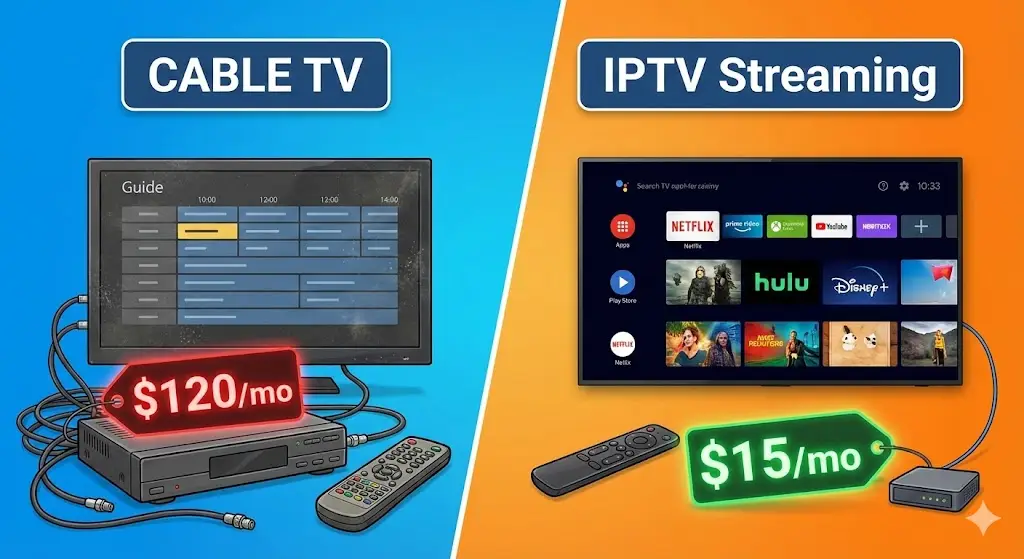
The battle for your living room has never been fiercer. For decades, a coaxial cable running from the wall to a dusty box was the only way to watch live sports or catching the evening news. Today, the landscape is entirely different. The debate of iptv vs cable is no longer just about technology; it is about freedom, cost, and control over what you watch.
As we move through 2026, millions of households are cutting the cord, tired of hidden fees and rigid contracts. But is Internet Protocol Television (IPTV) truly a viable replacement for the reliability of traditional cable? Or does the old guard still have advantages? In this comprehensive guide, we strip away the marketing hype and compare these two titans head-to-head.
What is the Core Difference?
Before analyzing the features, it is vital to understand how these technologies work, as this dictates their performance.
Cable TV relies on dedicated infrastructure. It uses fiber-optic or coaxial cables underground to send radio frequency signals to your television. It is a closed loop, meaning your neighbor’s internet usage generally doesn’t affect your TV signal.
IPTV, on the other hand, delivers television content over the internet—the same way you receive emails or browse websites. It turns your TV into a smart device that requests specific data packets (movies, shows, live streams) from a server.
The Cost Battle: Who Saves You Money?
This is usually the deciding factor for most families.
Cable TV: Historically, cable is expensive. In 2026, the average cable bill in the US hovers around $120 per month. This price often includes:
- Broadcast fees
- Regional sports surcharges
- Equipment rental fees (DVR boxes, remotes)
- Taxes and administrative costs
IPTV: This is where iptv benefits shine brightest. Most premium IPTV subscriptions cost a fraction of cable—typically between $10 and $20 per month. There are no equipment rental fees because you use devices you likely already own, such as a Firestick or Smart TV.
- Winner: IPTV wins by a landslide. You can save over $1,000 annually by switching.
Content Variety and Flexibility
When you sign a contract with a cable provider, you are locked into “bundles.” You might want ESPN and HBO, but to get them, you are forced to pay for 50 other channels like the Shopping Network or local obscure stations you never watch.
IPTV solutions offer a completely different approach.
- Global Access: Cable is local; IPTV is international. You can watch the Premier League with UK commentary, check news from Tokyo, and watch movies from Bollywood, all on the same playlist.
- Video on Demand (VOD): While cable has “On Demand,” it is often limited and filled with ads. IPTV services typically come with massive libraries of movies and series that function like a built-in Netflix.
However, cable does have one advantage here: Local Channels. Getting specific local news broadcasts can sometimes be trickier on IPTV than simply plugging in a cable box.
Reliability and Picture Quality
This is the most controversial point in the cable tv vs iptv debate.
Cable TV Stability: Cable is incredibly stable. Because it uses a dedicated line, it rarely buffers. It works even if your internet is down (provided you have a separate line). If you have slow rural internet, cable is often the safer bet for uninterrupted viewing.
IPTV Quality: In 2026, IPTV picture quality has skyrocketed. Many providers now offer 4K (UHD) streams that look sharper than the compressed 1080i signals used by many cable operators. However, this quality is dependent on your internet speed. If your Wi-Fi drops, your TV drops.
- Winner: Cable for stability; IPTV for potential picture quality (if you have high-speed internet).
Installation and Mobility
How easy is it to set up?
Cable:
- Requires a technician visit.
- Drilling holes in walls for cables.
- You are stuck watching TV in the room where the box is installed.
IPTV:
- Instant activation via email.
- No physical installation.
- Mobility: This is a huge game-changer. You can take your TVPlusStream services subscription with you on vacation. As long as the hotel has Wi-Fi, you have your TV channels. You can watch on your smartphone during your commute or on a tablet in the backyard.
The Verdict: Is IPTV Better?
The answer depends on what you value most.
Stick with Cable IF:
- You have very slow or unreliable internet (under 10 Mbps).
- You absolutely despise technology and want a “plug and play” experience with zero learning curve.
- You are not concerned about monthly costs.
Switch to IPTV IF:
- You want to save significant money.
- You want access to thousands of global channels and VOD movies.
- You prefer watching on multiple devices (TV, Phone, Laptop).
- You have a stable internet connection (25 Mbps or higher).
For the vast majority of modern users, the pros of IPTV far outweigh the cons. The flexibility and cost savings are simply too good to ignore in 2026.
Conclusion
The era of being tethered to a wall outlet is ending. While cable TV offers a legacy of stability, it cannot compete with the sheer value and versatility of internet-based streaming. The freedom to watch what you want, where you want, for a quarter of the price is the future of entertainment.
If you are ready to cut the cord and experience a truly modern viewing experience, explore the premium IPTV options available at . It’s time to take control of your TV.
FAQ: IPTV vs Cable Questions
Do I need a Smart TV for IPTV? No. While a Smart TV is convenient, you can use any TV with an HDMI port by adding an inexpensive device like an Amazon Firestick, Roku, or Android Box to run the IPTV software.
Is IPTV legal compared to Cable? IPTV technology itself is 100% legal. It is used by major corporations like Hulu and YouTube TV. However, third-party providers vary. It is important to choose a legitimate service to ensure your connection is secure and stable.
Does IPTV use a lot of data? Yes, streaming video is data-intensive. Watching HD content can use about 3GB per hour. If your internet plan has a low data cap, you will need to monitor your usage, whereas cable TV does not use internet data.